Psalm 95:1-11
It is the time of year when our hearts turn to thanksgiving. Psalm 95 is a psalm of thanksgiving. Here at the Bible In Your Hand, we want to wish you a very Happy Thanksgiving.
Come and Praise the LORD Vss. 1-5
The Psalmist tells us how to praise Him (vv. 1–2) and why we should praise Him (vv. 3–5). This is communal praise, not individual praise, although both are important. Our praise should be joyful and enthusiastic—he even commands us to shout (v. 1, nasb)—and wholly focused on the Lord. The verb “come” in verse 2 means “to go to meet God face-to-face, to be in His presence.” Believers today do this through Jesus Christ (Heb. 10:19–25). We should be thankful in our praise as we extol the Lord for His great mercies. (On God the Rock.)
Why should we praise Him? Because God is great and above the false gods of this world. After His ascension to heaven, Jesus Christ was enthroned “far above all,” and nothing can separate us from His love. He is our “great God and Savior,” and we should delight in praising him. But our God is also the Creator of the universe and controls all things (vv. 4–5). The depths of the sea and the earth and the heights of the mountains all belong to Him, and He knows what is going on in the waters and on the earth. The pagan nations had gods and goddesses for different parts of creation—the seas, the land, the mountain peaks, the sun, moon and stars, the storms, the crops—but our God is King over all. No wonder we praise Him!
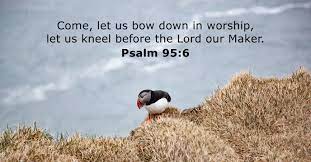
Bow Down and Worship the Lord vss. 6–7a
Praise means looking up, but worship means bowing down. Alas, some people who enjoy lifting their hands and shouting do not enjoy bowing their knees and submitting. True worship is much deeper than communal praise, for worship involves realizing the awesomeness of God and experiencing the fear of the Lord and a deeper love for Him. Too often, Christian “praise” is nothing but religious entertainment, and it never moves into spiritual enrichment in the presence of the Lord. Our singing must give way to silence as we bow before the Lord. He alone is Jehovah, the Lord, the covenant-making and covenant-keeping God. He is our Maker and our Shepherd. (See 23 and John 10.) Jubilation has its place only if it becomes adoration and we are prostrate before the Lord in total submission, “lost in wonder, love, and praise.” What a remarkable miracle of grace that we sinners should be called “His people.” He made us, He saved us, and He cares for us! Why should we hesitate to fall before Him in total surrender?
Hear, Hear, and Obey the Lord vss. 7b–11
The Word of God is a vital part of Christian worship, especially in this age when inventing clever new worship forms is a common practice and novelty replaces theology. Hearing and heeding God’s Word must be central if our private or corporate worship is to be genuinely Christian. It isn’t enough for God to hear my voice; I must listen to His voice as the Word of God is read, preached, and taught. The Scriptures written centuries ago have authority today, and we have no right to ignore them, change them, or disobey them. We are to respond to God’s Word now when we hear it, and not just later in the week when we review our sermon notes or listen to the message on YouTube. It is tragic when worshipers go home with full notebooks and empty hearts! (Please see Hebrews. 3:7–4:13, where this passage is applied to the church today, warning us not to harden our hearts against the Lord.) The way we treat the Word of God is the way we treat the God of the Word. Jesus admonishes us to take heed of what we hear (Matt. 13:9), take heed of what we hear (Mark 4:24), and take heed of how we hear (Luke 8:18).
The writer reached back and cited two tragic events in the history of Israel—the nation’s complaining at Rephidim (Ex. 17:1–7) and their unbelief and disobedience at Kadesh Barnea (Num. 13–14). The Jews had seen God’s wonderful works in Egypt, especially His defeat of the Egyptian army when He opened and closed the Red Sea—but they refused to trust Him for their daily needs. No sooner were they liberated from Egypt than they complained that they were hungry, so He sent them the manna, the bread of heaven (Ex. 16). When they arrived at Rephidim, the people complained again because they were thirsty (Ex. 17:1–7). Instead of trusting God, they blamed God and His servant Moses. God graciously gave them water out of the rock, but Moses commemorated the event with two new names for the site: Meribah means “strife, quarreling, contention,” and Massah means “testing.” (See also Num. 20:1–13.) Instead of trusting God, the people contended with God and even tempted Him with their arrogant attitude and words. He could have sent immediate judgment, and they dared Him to act.
Israel spent a year and two months at Sinai (Num. 10:11) and then departed for Kadesh Barnea, the gateway into Canaan (Num. 13–14). Here, they refused to trust the Lord and obey His orders to enter the land and claim their inheritance. In spite of all they had seen Him do, the Israelites hardened their hearts and refused to do God’s will. God judged His people at Kadesh Barnea and consigned them to thirty-eight years in the wilderness while the older generation died off. It was the world’s longest funeral march. “They shall not enter into My rest” (v. 11; Num. 14:26–38). The writer of Hebrews used this event to warn Christians not to harden their hearts and thereby fail to claim what God had for them to do, receive, and enjoy. God has a perfect plan for each of His children (Eph. 2:10), and we claim that inheritance by faith in God’s Word is the kind of faith that leads to obedience.
In Moses’ day, God’s “rest” was the land of Canaan, where the Jews would do no more wandering (Ex. 33:14; Deut. 12:9–10; Josh. 1:13, 15). But Hebrews 4 broadens the meaning of “rest” to include the salvation, rest, and inheritance we have in Christ and the future eternal “Sabbath rest” in glory. Hebrews 1–4 is God’s admonition to the church today to live by faith, and “faith comes by hearing, and hearing by the word of God.” Because the Jews refused to hear His Word but hardened their hearts instead, God was disgusted with His people, and all the people twenty years old and older died during that wilderness journey. We harden our hearts when we see what God can do but refuse to trust Him so He can do it for us. We fail to cultivate a godly heart that fears and honors the Lord. It is a grievous sin to ask for gifts (food, water, etc.) but ignore the Giver, and the consequences are painful.


 Pastor Lester Bentley