John 4:13-20
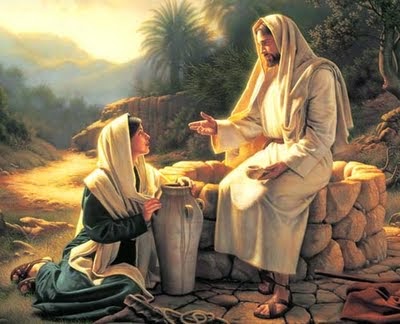
The disciples have gone to purchase food in the nearby town of Sychar in Samaria. This is near the plot of ground Jacob had purchased for Joseph. It is also where Jacob dug a well that was over 100 feet deep. It is midday, according to the sundial, near the sixth hour. Jesus has stopped to rest and is alone when a woman of Samaria approaches to draw water. Jesus, being tired and thirsty, engages her in a conversation, asking her for water to drink, and in the conversation that follows, He offers her living water.
“The woman said to Him, ‘Sir, You have nothing to draw with and the well is deep. Where, then, do You get living water? Are You greater than our father Jacob, who gave us the well, and drank from it himself, as well as his sons and his livestock’” (John 4:11, 12).
She is right; looking at Jesus, He was a typical Jewish man. There was nothing in his physical features to distinguish Jesus from any other man, and he had no means of drawing water, and this was the only nearby source of water. Therefore, we can understand her statement, “Where then do You get living water?” What seemed unusual to her was that He, being a Jew, was talking with her.
“Jesus answered and said to her, ‘Whoever drinks of this water will thirst again, but whoever drinks of the water that I shall give him will never thirst. But the water that I shall give him will become in him a fountain of water spring up into everlasting life’” (John 4:13, 14).
The woman’s attention is focused on the water in the well before her. Her desire is not to have to come to the well every day to draw water. Jesus says to her, the water in this well will cause you to thirst again. But I have something different to offer. Water that when you drink, you will never thirst again. “Actually,” Jesus said, “That living water, when you have drunk of it, will then spring forth from you into everlasting life.”
In verse 15, you can see how anxious she is to receive this water, for she is tired of the burden of carrying water from well to house. She wants relief from her burden. So she asks, “That I may not thirst, nor come here to draw.”
In the story of Nicodemus, we see that Jesus is the discerner of hearts. Jesus understood the darkness that was in Nicodemus’s heart. Hear with this woman, Jesus read the heart of this Samaritan woman and saw her thirsting for something better. So Jesus said to her, “Go, call your husband, and come here.”
The next statement is the woman’s response, which is often given as a reason why she was at the well to draw water at midday instead of early morning with the other woman. Remember when I started talking about this story? I asked you to put away your Christian ideals and Western beliefs and look at this story through the eyes of an ancient Near Eastern person. To place your Christian ideas and Western thinking upon this story causes us not to understand the culture of Jesus’s day. Or even to somewhat understand the condition of many people in the culture in which we live.
She responded, “I have no husband” (John 4:17a). Jesus responded, “You have well said, I have no husband: for you have had five husbands, and the one whom you now have is not your husband; in that you spoke truly” (John 4:17b, 18).
We are quick to point our finger and say, see, she was a great sinner and not deserving and thus ridiculed by the other women of the community. Therefore, she had to come to the well at a time when the other women were not there. To think this is a misunderstanding of what is really happening.
Let me explain. In the Ancient Near East, women were considered less than second-class citizens. Meaning they and their children were treated as property. Not unlike it is today in the Middle-Eastern countries. Therefore, if a woman lost her husband because of death, she had no means of making a living unless her children were old enough to support her. Therefore, she was often forced to turn to a life of prostitution to support herself. Yes, I can hear some of you saying, see, I told you, she was rejected by the other women, and that is why she was there midday. But the text says she has had five husbands and was living with someone else.
If her husband died, hopefully, there was enough money in the dowry that she could support herself for a period of time until she was able to find another husband.
Let’s look at the family of Jesus for a moment to help explain this. The scriptures are clear: Joseph had been married before, and a careful reading of the gospels indicates that Joseph already had six children before he became betrothed to Mary. We do not know what happened with his first wife. Possibly, she died, perhaps in childbirth. But Mary is a teenager being married into an already made family of six children of an older man. Life expectancy was much lower as people died from the complications of childbirth and diseases.
For Joseph, the need to find another wife is not as high as it would be for the Samaritan woman to attach herself to another man to support her so she would not be forced into prostitution as a means of supporting herself. To be fair, the scriptures do not indicate if any of her five previous marriages had ended in divorce or death. And the fact that she lived with someone she had not married would have prevented her from having to resort to prostitution.
What is clear is that Jesus was presenting a fact, not condemning her behavior. He wanted her to see He was a discerner of her heart, so it would trigger a reaction from her. We will get to that in a moment. But first, I want to apply what we have learned about the woman to society today. All around, I see marriages disintegrating for various reasons. Men and women have had several marriages for various reasons, death and divorce to name two, and to find a couple living together outside of marriage is common, at least in western societies. Women in Christian societies and the West certainly have more opportunities to support themselves as a single person than those at the time of Christ. So, we should not be so quick to condemn this Samaritan woman, when we to have multiple marriage and live with another outside of marriage.
One last thing: I do see within her a longing for something better. Maybe the multiple relationship is her trying to find the love and satisfaction she longed for. But for us to call her an out cast of society, does not make sense in that she later appeals to the people of Sychar to “Come meet the one that told me everything about me” (John 4:29 paraphrased). If she had been an outcast, they never would have followed her to Jesus.
Verses 19, 20: “Sir I perceive that You are a prophet. Our fathers worshiped on this mountain, and you Jews say that in Jerusalem is the place where one ought to worship.”
This is another indication of the hostility between these two groups because it was almost a thousand years earlier that Israel had Northern Kingdom and Southern Kingdom. Samaria was part of the former Northern Kingdom.
I had hoped to get through verse 26 today. However, it has taken a while to set up what is to come. But the point I want to leave us with is, Jesus does not condemn her. He treats her with respect and dignity. He engaged her in conversation. By doing so, he hoped to engage her in a conversation regarding the gospel message. And as we will see, Jesus reveals more to her than He did with Nicodemus. Within this story, Jesus not only offers her living water, but demonstrates what living water looks like in His treatment of her and giving her the good news of the gospel.

 Pastor Lester Bentley