John 5:1-7
Within John 5:1-12:50 is the public ministry of Christ. Within these passages, Jesus attends three festivals, and all these festivals take place in Jerusalem. It is important to note that Matthew, Mark, and Luke primarily focus on Jesus’s ministry in Galilee, while John, for the most part, centers Christ’s ministry in Jerusalem. Naturally, John 5:1 starts by saying, “After this, there was a feast of the Jews, and Jesus went up to Jerusalem” (John 5:1). The author again wants us to understand that this is a continuation of the last four chapters. This also means this is the second Passover Jesus has attended since his baptism. We saw at the last Passover, in John 2:13-22 that Jesus cleansed the temple. The cleansing of the Temple caused a certain Pharisee, Nicodemus, to seek a Midnight conversation with Jesus, who discerned within the heart of this Pharisee that his heart needed to be circumcised or born again. Then upon leaving Judia for the region of Galilee, he had stopped in Samaria to have a Divine appointment with a woman that resulted in a great harvest of Samarians as He revealed to them that I am the great I Am the Messiah. The nobleman’s son was healed. Jesus offered her living water and let’s be reminded in John 2:1-11 Jesus turns water into wine. These play a role in our understanding of John 5:1-15.
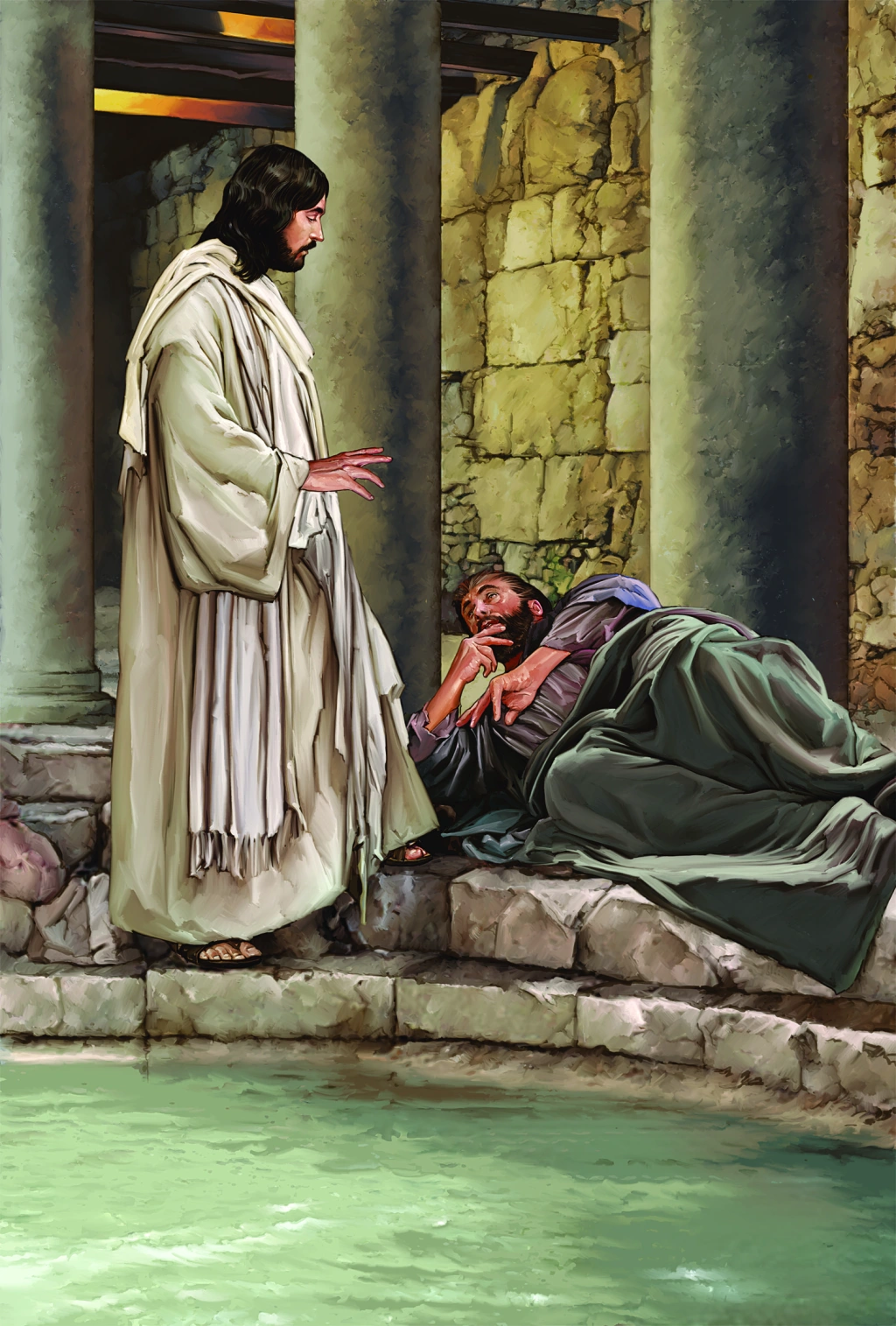
Now, Jesus is returning to Jerusalem for the Passover. For “Now there is in Jerusalem by the Sheep Gate a pool, which is called in Hebrew, Bethesda, having five porches” (John 5:2). The name Bethesda means “house of mercy.”
John 5:3 and 4 serve as contextual background, giving the Gentile reader information pertinent to the story. I will comment more on this later. But first, let’s read them together. “In these (the five porches) lay a great multitude of sick people, blind, lame, paralyzed, waiting for the moving of the water. For an angel went down at a certain time into the pool and stirred up the water; then whoever stepped in first, after the stirring of the water, was made well of whatever disease he had.”
It is interesting that Jesus could have entered Jerusalem by any of the gates, and if the Sheep Gate were the closest point of entry, He would not have had to go through the porches at Bethesda seeing those that were lying under its shade at the pool of Bethesda. The path led just far enough away, but Jesus seems to have purposely entered this area where all these blind, lame, and paralyzed people lay. I just cannot help but think how miserable the condition of these people might have been. I also cannot help but imagine the wretched condition and the smell that arose from this place. Yet, Jesus deliberately chose to walk through Bethesda on his way to the temple.
“Now, a certain man was there who had an infirmity thirty-eight years. When Jesus saw him lying there, and knew that he already had been in that condition a long time. He said to him, ‘Do you want to be made well’” (John 5:5,6). Jesus’s question is a question regarding this man’s faith. Jesus is essentially asking, “Do you have the faith necessary to want to be made well.” Hey friend, I see you have been here a long time. Do you want to be made well? Do you have enough faith to believe you can be made well?”
“The sick man answered Him, ‘Sir, I have no man to put me into the pool when the water is stirred up; but while I am coming, another steps down before me’” (John 5:7). Remember just a moment ago, when we dwelt on verses 3 and 4, I said that I would come back to this. Some translations omit verses 3 and 4 or combine them into one verse. Here is why. The original manuscripts do not have verses 3 and 4 in them. They were inserted to give clarity, and the two verses we just read, verses 6 and 7, give validity to the above statement. But it was also added that we better understand the response of the crippled man to the question asked, “Do you want to be made well?”
What is fantastic is that verses 3 and 4 give credibility to the man’s statement in verse 7, and verse 7 gives us evidence of this man’s great faith. I hear some asking, “In what way does this illustrate this man’s great faith? It is a fair question and deserves to be answered.
Jesus asks this crippled man, “Do you want to be made well” (John 5:6))?Note the man’s immediate response. “Sir, I have no man to put me into the pool when the water is stirred up, but while I am coming, another steps down before me” (John 5:7)! There is the humor question and the response by the crippled man, which really is not a humorous situation at all. He is lying beside a pool of water, wanting to be first into the pool so he can be made well. So, of course, he wants to be made well. For thirty-eight years, he has wanted to be made well. The best commentary on the life of Christ states that this man’s condition had, by this time, left him at the point of death. Who in that condition would not want to be made well?
The infirmed Jews around the pool called the House of Mercy believed that God, through his angels, would cause the pool to be stirred up. At that time, the person first into the water would be healed. What brought them to this conclusion?
Before we continue, Let’s drop back to verse 5. Let me ask you a question: How many years had this man suffered? The answer is 38 years. Is there another time in the scriptures when 38 years is implied or stated? Yes, when the children of Israel wandered in the desert for 38 years. Why did they wander in the desert for 38 years? Because of their unbelief, they refused to rely upon God and thus failed to enter the promised land after only two years away from Egypt, with most of those two years spent at Mount Sinai learning of God’s law and building the Tabernacle so that God could dwell with them. Oh, yes! The law they were learning was to serve as an object lesson on what all of heaven was doing on their behalf to attain salvation and to enter the promised land.
Therefore, verse 6 sets up the issue, which is being addressed by Jesus, by asking the question of this man to show if he has faith or not. The response of the invalid beside the pool gives validity to verses 3 and 4, but also gives an answer to the question in verse 6 regarding faith. The fact that this man was sick for 38 years begs us to ask the question, is Israel’s faith stronger at the time of Jesus than it was after they had spent nearly two years at Mount Sinai? Or is their faith misplaced, meaning they are placing their faith in something other than God? The answer will surprise you.
In our next post, we will pick up at this point and answer this question and see what Jesus is wanting us to see in this true-life event.

 Pastor Lester Bentley